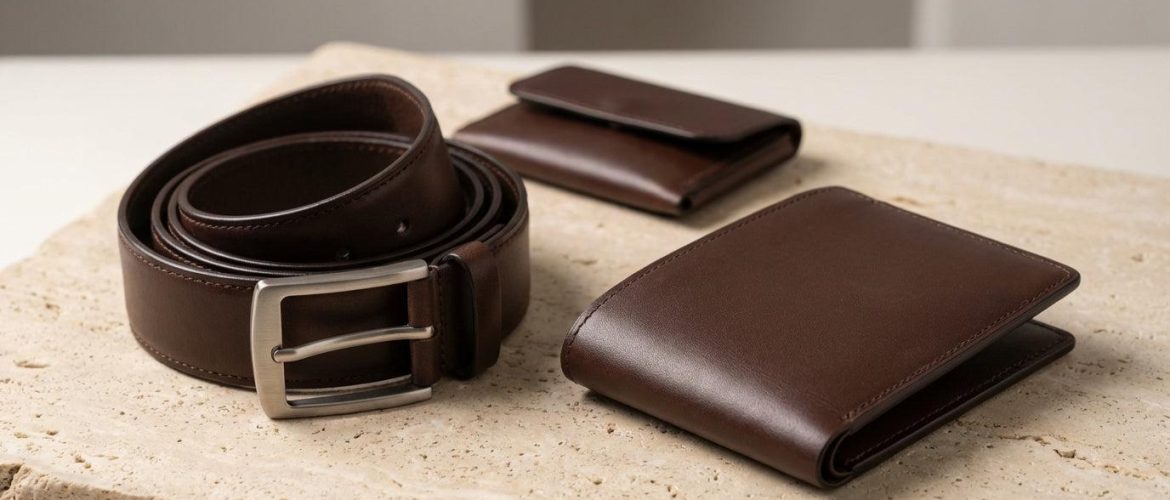
Quiet Luxury Accessories: Belts, Wallets and Eyewear
A belt is handled almost every morning, a wallet accompanies its owner for years, and a pair of spectacles may be worn for most of the waking day. These are among the most familiar objects in a wardrobe, yet their quality is frequently judged by the least interesting thing about them: the name of the manufacturer.
The finest accessories invite a more considered examination. The leather of a belt should possess the right balance of suppleness and strength. A wallet should accommodate its contents without becoming misshapen. Eyewear must sit comfortably on the face, with proportions that complement the wearer and lenses appropriate to their purpose. These qualities become apparent through repeated use, long after the initial pleasure of a purchase has passed.
Quiet luxury accessories are particularly interesting because their design leaves little room for unnecessary decoration. A simple leather belt depends on the quality of its hide, the finishing of its edges and the proportions of its buckle. A slim wallet exposes the precision of its stitching and the intelligence of its construction. An understated pair of glasses succeeds through the relationship between frame, lens and face.
For readers already familiar with the established luxury houses, the more rewarding discoveries often come from specialist manufacturers whose reputations rest on a particular craft. Their work offers a different understanding of luxury, one rooted in the satisfaction of owning something exceptionally well made.
The Detail That Replaces the Logo
The absence of visible branding has become one of the most recognisable characteristics of contemporary quiet luxury. Yet a product without a logo is not necessarily discreet, and an unmarked accessory is not automatically exceptional.
Certain design signatures have become as recognisable as conventional branding. Bottega Veneta’s intrecciato leather, the Hermès Kelly fastening and Persol’s silver arrow are all distinctive visual codes. Their success demonstrates that a manufacturer can establish an identity through construction or hardware rather than through printed lettering.
The distinction becomes more interesting when the design element serves a practical purpose. A buckle should fasten securely and adjust comfortably. A wallet’s edges should protect the leather and withstand handling. A spectacle hinge should open smoothly, retain its alignment and accommodate the movement required during everyday wear.
The best details are those that improve the object while contributing to its appearance.
This is why specialist makers deserve attention. A leatherworker who has spent decades refining a particular construction method may produce an accessory whose quality is apparent without reference to the manufacturer’s reputation. The appeal lies in the object itself, although an appreciation of the techniques behind it can make ownership more satisfying.
The Belt: A Small Object With Considerable Influence
Few accessories alter the proportions of an outfit as effectively as a belt. Its width, colour, buckle and placement can change the relationship between upper and lower garments, making it an important detail in both men’s and women’s dressing.
A narrow belt worn with high-waisted trousers can introduce definition without interrupting the silhouette. A slightly wider leather belt may provide the necessary balance beneath a substantial jacket, while a soft suede design can complement relaxed tailoring.
The most versatile examples tend to have restrained hardware and carefully finished leather. A polished buckle can bring formality to a belt, while brushed metal creates a softer impression. Brass develops a different character from stainless steel, and the choice should be considered in relation to the jewellery, watch and other metal details worn nearby.
The leather itself deserves particular attention. Full-grain leather retains the natural surface of the hide and can develop an attractive patina, although quality also depends on tanning, finishing and construction. A belt made from several layers of leather may behave differently from one cut from a single substantial piece, and neither approach is inherently superior.
What matters is how the belt responds to repeated fastening, movement and tension.
The Importance of the Buckle
The buckle is often the most visible part of a belt, but its mechanical qualities are easily overlooked. A beautifully proportioned fastening should operate smoothly, hold securely and avoid unnecessary weight.
Traditional pin buckles remain popular because they are simple, dependable and relatively easy to repair. Sliding and adjustable mechanisms can offer greater flexibility, particularly when a precise fit is required.
The proportions should suit the belt and the clothing. A large buckle on a narrow strap can appear unbalanced, while an excessively delicate fastening may look incongruous on substantial leather.
There is no reason to reject decorative hardware entirely. A sculptural buckle can become an attractive feature of an otherwise restrained outfit. The important consideration is whether its design contributes something beyond the recognition of a particular brand.
The Leatherworkers Worth Discovering
The familiar luxury houses produce many excellent belts, but specialist leatherworkers offer an alternative for buyers interested in materials, individual commissions and traditional techniques.
Equus Leather, a British maker associated with bridle leather and traditional leatherworking, is worth exploring for its approach to belts and small leather goods. The appeal of this kind of specialist work lies in the selection of hides, careful edge finishing and attention to components that receive repeated use.
Bridle leather has particular relevance because it is traditionally prepared for applications requiring strength and durability. Its characteristic finish can develop with wear, although the quality and behaviour of the leather depend on the tannery and the specific treatment used.
For those who prefer a more individual approach, Duret Paris represents the bespoke end of the category. Its leather accessories can be considered in relation to personal preferences concerning colour, material, dimensions and hardware, rather than selected solely from a conventional seasonal collection.
Bespoke work is not automatically necessary for an everyday belt. A well-made ready-to-wear design may provide an excellent fit and years of service. Its value becomes more apparent when a buyer requires unusual dimensions, a particular leather or a fastening that is difficult to find elsewhere.
The advantage of a specialist maker is the opportunity to understand the construction and make decisions based on the object rather than the reputation of a fashion house.
The Wallet: Luxury Intended for the Owner
The wallet occupies a curious position in the luxury accessories market. It is one of the most frequently handled personal possessions, yet it is rarely visible for long enough to communicate much about its maker.
That makes it a particularly interesting test of craftsmanship. A wallet should feel comfortable in the hand, open naturally and provide sufficient space for its intended contents without unnecessary bulk.
The design has also changed with the way people carry money. Contactless payments and digital wallets have reduced the need for substantial collections of cards, receipts and cash, although preferences vary considerably between individuals and countries.
For some, a slim cardholder is sufficient. Others still require a compact billfold or a wallet with dedicated compartments for notes, coins and identification.
The most sophisticated solution is not necessarily the smallest. It is the one whose construction accommodates its contents without placing excessive strain on the leather or stitching.
What Makes a Fine Leather Wallet?
A beautifully made wallet can reveal its quality through details that are almost invisible when it is closed.
The edges should be finished appropriately for the leather and construction. Painted edges require careful preparation and application, while folded or turned edges demand precision in cutting and assembly. Both methods can produce excellent results when properly executed.
Stitching should be consistent and suited to the intended use. Traditional saddle stitching is valued for its strength and repair characteristics, but carefully executed machine stitching can also provide excellent durability.
The interior deserves as much attention as the exterior. Card slots should be sufficiently secure without requiring excessive force, and the lining should withstand repeated contact with cards and other objects.
Leather thickness is another important consideration. An exceptionally thick hide may feel substantial but create unnecessary bulk, while leather that is too thin for its application may stretch or deteriorate.
The skill lies in selecting and preparing materials that provide the right combination of strength, flexibility and refinement.
The Wallet Makers Worth Knowing
Among established luxury leather houses, Valextra offers a particularly interesting example of design expressed through construction. Founded in Milan in 1937, the house has developed a recognisable identity through architectural forms, precise proportions and its distinctive Costa edge finishing.
Its small leather goods demonstrate how careful edge treatment can become an aesthetic feature. The contrast between the leather surface and the finished edge gives otherwise simple objects a recognisable character without requiring prominent exterior branding.
For readers seeking a more specialist approach, Ettinger provides a British perspective on fine leather accessories. Founded in 1934, the house is associated with wallets, cardholders and other small leather goods, often combining restrained exterior designs with contrasting interior colours.
The appeal of a carefully made Ettinger wallet lies in the relationship between practical construction and traditional leatherworking. Its designs are generally intended for regular use, with attention to the dimensions and arrangement of compartments.
Peter Nitz, the Zurich-based leather craftsman, offers another perspective through bespoke leatherwork and individually considered accessories. His approach is particularly relevant to buyers who appreciate the relationship between maker and client, and who may wish to commission an object in a specific leather or finish.
These houses occupy different positions within the market, but each illustrates an important principle: the quality of a wallet is best assessed through the materials, construction and pleasure of using it.
The presence or absence of a famous name should be a secondary consideration.
Eyewear: The Most Personal Accessory
Eyewear is arguably the most demanding accessory to choose well because it sits directly on the face. Its proportions affect how the wearer’s features are perceived, while its weight, balance and optical performance influence comfort throughout the day.
A beautifully made frame can be unsuitable for someone if its bridge does not sit correctly, its temples apply excessive pressure or its shape conflicts with the proportions of the face.
This is why eyewear deserves a more individual approach than many other accessories. The best frame is not necessarily the one that looks most attractive in isolation. It is the one that complements the wearer and remains comfortable after several hours.
Materials are important, but their value depends on execution. High-quality acetate can provide depth of colour and a pleasing finish, while titanium offers lightness and strength. Precious metals may introduce additional decorative possibilities, although they are not automatically more comfortable or durable than well-engineered alternatives.
The quality of the hinges, the finish of the temples and the ability to adjust the frame are equally significant.
For prescription eyewear, the lenses deserve particular attention. Their optical quality, coatings, thickness and suitability for the prescription can matter more to everyday satisfaction than the prestige of the frame manufacturer.
Persol and the Heritage of Technical Design
Founded in Turin in 1917, Persol has a long association with Italian eyewear and a recognisable approach to frame design.
Its Meflecto system was developed to provide flexibility in the temples, helping frames accommodate different head shapes. The company’s characteristic arrow detail has also become one of the most recognisable signatures in eyewear.
The Persol 714, associated with Steve McQueen, remains an important reference in the history of folding sunglasses. Its design demonstrates how a functional idea can become a lasting part of a manufacturer’s identity.
Persol is not an obscure brand, and its arrow is certainly recognisable. Its relevance to a discussion of quiet luxury lies in the relationship between technical development, classic proportions and practical design.
For someone who appreciates heritage eyewear, the most interesting details are often the ones that improve fit and function rather than those intended primarily for display.
Jacques Marie Mage and the Appeal of Limited Production
Jacques Marie Mage approaches luxury eyewear through a very different design philosophy.
Founded by Jérôme Mage, the brand is known for substantial acetate frames, carefully developed hardware and collections influenced by historical figures, architecture, music and cultural references.
Many of its frames are produced in limited editions, often using Japanese manufacturing expertise and distinctive construction details.
The designs can be bold, and some are immediately recognisable to eyewear enthusiasts. They are therefore not universally discreet in appearance. Their relevance lies in the seriousness with which the brand approaches materials, proportions and manufacturing.
A substantial acetate frame can be beautifully balanced when its dimensions suit the wearer. The thickness of the material, the shaping of the bridge and the relationship between lens and temple all influence the finished result.
For collectors, Jacques Marie Mage offers a combination of design character and specialist manufacturing. For someone seeking a very light, unobtrusive everyday frame, a different maker may be more appropriate.
The choice should begin with the face and the intended use, not with production numbers or exclusivity.
The Independent Eyewear Alternative
Beyond the familiar heritage names, independent eyewear specialists offer some of the most interesting work in the category.
Lunor, the German eyewear house, has developed a reputation for restrained frames, classic shapes and careful attention to proportion. Its designs frequently draw on historical eyewear forms without relying on conspicuous decoration.
The brand is particularly relevant to readers who prefer lightweight, understated spectacles and appreciate the relationship between traditional design and modern manufacturing.
Matsuda, the Japanese eyewear maker, offers a more decorative interpretation of craftsmanship. Its frames can incorporate intricate metalwork, carefully engraved details and combinations of materials that reward close examination.
The results are sometimes more expressive than the conventional quiet luxury aesthetic, but their interest lies in the quality and complexity of the construction rather than prominent branding.
These two houses illustrate the breadth of specialist eyewear. One may favour visual restraint and classic proportions, while the other explores elaborate detail and technical craftsmanship.
Neither approach is inherently more luxurious. The appropriate choice depends on the wearer’s face, preferences and appreciation of design.
The Tortoiseshell Tradition
Tortoiseshell-patterned eyewear has remained popular for generations because its warm mixture of amber, brown and darker tones can complement a wide range of complexions.
Modern frames generally reproduce the appearance using acetate or other manufactured materials rather than actual tortoiseshell. This distinction is important, given the conservation concerns and legal restrictions associated with products made from protected turtle species.
The pattern itself offers considerable variation. Dark Havana frames can provide a relatively formal appearance, while lighter combinations of honey, tobacco and caramel may soften the face.
The scale of the pattern also matters. Large, high-contrast markings create a different impression from finely blended tones, particularly when combined with a substantial frame.
Material claims deserve scrutiny. Some manufacturers use bio-based acetate or other materials with plant-derived components, but the environmental characteristics of a frame depend on its full composition, manufacturing process and disposal arrangements.
A material described as bio-based should not automatically be assumed to be biodegradable or environmentally superior in every respect.
The most enduring reason to choose tortoiseshell-patterned eyewear remains aesthetic. It introduces warmth and visual interest without requiring a prominent logo, and it can work beautifully with both formal and casual clothing.
Choosing Accessories That Work Together
The most successful accessories rarely appear to have been purchased as a matching set. Their relationship is usually more subtle, established through colour, proportion, material and the character of their hardware.
A chocolate leather belt can complement dark brown suede shoes without matching them exactly. A slim black wallet may have no visual relationship with the wearer’s eyewear, yet both can reflect the same appreciation of restrained design and careful construction.
There is also no requirement for every metal detail to share the same finish. A brushed silver belt buckle can work alongside a gold watch or jewellery when the overall composition is balanced.
The objective is not uniformity. It is to avoid unnecessary competition between individual pieces.
A distinctive pair of glasses may be the most expressive element in an outfit, while the belt and other accessories remain comparatively simple. On another occasion, a sculptural buckle or unusual leather colour may provide the point of interest.
This approach allows accessories to reflect personality without becoming a collection of recognisable status symbols.
The Practical Value of Craftsmanship
Luxury accessories are often discussed in terms of rarity and prestige, but their most meaningful qualities frequently become apparent through maintenance and long-term use.
A good leather belt should withstand repeated fastening without quickly losing its shape. A wallet should remain functional as its leather softens. A well-made spectacle frame should retain its alignment and accommodate adjustments when necessary.
Repairability is therefore worth considering before purchase.
Some leather goods can be restitched, refinished or repaired by skilled specialists. Certain belt buckles can be replaced, while eyewear frames may permit hinge repairs, adjustments and replacement lenses.
Not every expensive accessory is designed with these possibilities in mind. Delicate decorative hardware, unusual coatings and proprietary components can make repairs more difficult.
A knowledgeable buyer should therefore ask practical questions about maintenance, available repairs and the expected behaviour of the materials.
These considerations may be less glamorous than a manufacturer’s history or a product’s scarcity, but they often determine whether an accessory remains satisfying to own.
The Pleasure of the Familiar Object
There is something particularly satisfying about an accessory that becomes familiar through daily use.
A leather wallet gradually acquires the shape of its contents. A belt develops subtle variations in its surface where it is handled most often. A pair of glasses becomes so comfortable that its owner scarcely notices wearing it.
These changes are part of the relationship between an object and the person who uses it. They are also difficult to reproduce through the purchase of something new.
The best quiet luxury accessories are not necessarily those that attract the least attention, nor those that are recognised only by a small circle of enthusiasts. Their value lies in how intelligently they have been designed and how well they serve their purpose.
A beautifully made belt, wallet or pair of spectacles should provide pleasure through its materials, construction and everyday performance. The manufacturer’s reputation may explain why the object deserves consideration, but it should never be the only reason for owning it.
Over time, the most successful accessories become less associated with their makers and more closely associated with the people who carry and wear them.
That familiarity is perhaps their most enduring luxury.
Frequently Asked Questions
What are quiet luxury accessories?
Quiet luxury accessories are belts, wallets, eyewear and other personal items distinguished by quality materials, refined design and careful construction rather than conspicuous branding. Their appeal lies in craftsmanship, practicality and the pleasure of everyday use.
Which brands make quiet luxury belts?
Specialist leatherworkers such as Equus Leather and bespoke makers such as Duret Paris are worth exploring. Established luxury houses also produce understated belts, but the quality of the leather, buckle and construction matters more than the name.
What makes a luxury wallet worth buying?
A fine wallet should combine quality leather, precise stitching, appropriate edge finishing and practical compartments. Its dimensions should suit the contents it carries, and its construction should withstand repeated daily use.
Which eyewear brands are associated with quiet luxury?
Persol, Lunor, Matsuda and Jacques Marie Mage offer different approaches to quality eyewear. Some favour classic restraint, while others emphasise intricate craftsmanship or distinctive design. Fit and optical performance should remain the principal considerations.
Are tortoiseshell sunglasses considered quiet luxury?
Tortoiseshell-patterned sunglasses can complement an understated wardrobe because their warm colours and traditional appearance provide visual interest without requiring prominent branding. Modern examples generally use acetate or other manufactured materials rather than genuine tortoiseshell.
Do quiet luxury accessories have to be completely logo-free?
No. The absence of visible branding can contribute to a discreet appearance, but it does not guarantee quality. A well-designed accessory should be judged primarily by its materials, construction, comfort and suitability for the wearer.
EXPLORE LXRY
_____________
From exceptional travel and private experiences to fine watches, fashion, interiors and specialist services, LXRY connects readers with a carefully selected network of luxury businesses.
Many of the hotels and specialists we write about are ones we have known and worked with over the past decade. If something here has caught your interest, tell us what you have in mind and we will point you in the right direction.
Enquire Now