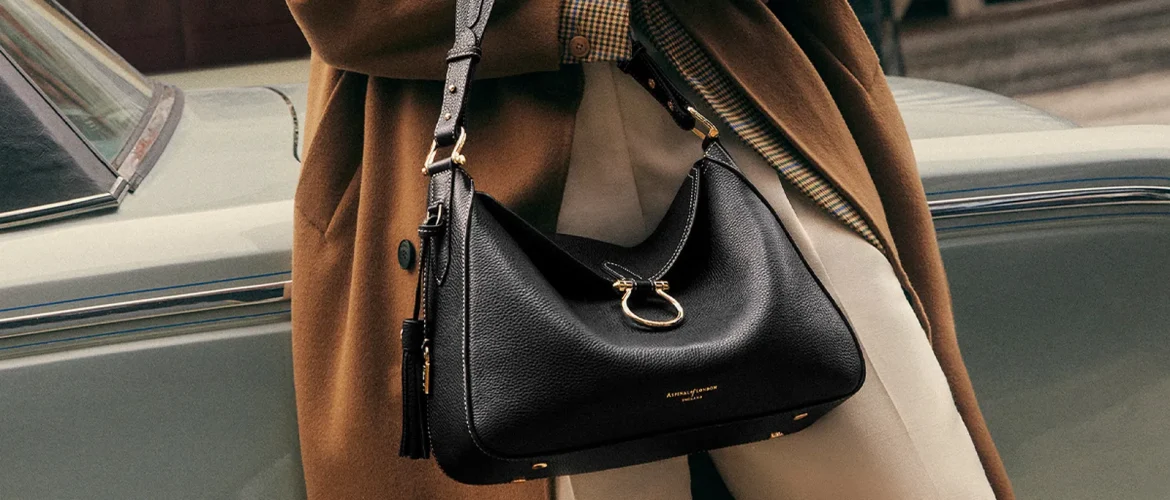
Quiet Luxury Handbags: The Bags That Don’t Need a Logo
Status in leather goods has flipped. The bag that matters now is one a stranger cannot place and a small number of people recognise at once. For some owners the pleasure lies in that recognition, in being understood by people who know. For many others it lies in the object alone: the weight of good leather in the hand, an edge finished with patience, a shape that improves with years of use. Either way, the bag no longer needs a name on the outside to justify itself.
Why the logo lost its power
A signal works only while it stays scarce. Once a monogrammed bag is seen in every airport and copied on every market stall, it says little about its owner beyond a wish to be noticed. Research into luxury pricing has long found that counterfeiters favour the loudest designs, because a copy only has value if strangers recognise it. The quieter the design, the less there is to forge.
The buyers who moved away from logos first were rarely trying to look modest. They wanted their bag to express something more personal than money, such as their own judgement or their relationship with a maker. That is a harder thing to buy, and it begins with knowing how to judge a bag that carries no name.
The touch test
When there is no logo to vouch for a bag, the work has to prove itself in the hand. A few minutes with a bag will tell someone who knows where to look most of what separates a great bag from a good one.
| What to check | What it tells you |
|---|---|
| The edges | Well-finished edges are smooth and even, with no cracking, whether painted, burnished or turned |
| The stitching | Stitches should be regular and tight, and hand saddle-stitching sits at a slight, consistent angle |
| The leather | Fine leather has depth and a natural grain, and it softens with handling rather than creasing sharply |
| The hardware | Fittings should be solid, precisely aligned and in proportion to the bag, closing cleanly without rattle |
| The interior | Lined or unlined, the inside should be finished with the same care as the outside |
None of these points depends on a single rule. Heavy hardware suits a structured case and would spoil a soft pouch, and a lining can protect a bag as well as hide its seams. The question is always whether each choice serves the design. A plain bag makes that easy to judge, because there is nothing on its surface to distract from the work.
The houses worth knowing
Each house below signs its work through construction and materials rather than branding, and most remain little known outside the circle that seeks them out. Several also appear in our wider guide to the quiet luxury brands worth knowing. Here the focus narrows to what makes their bags distinctive.
Joseph Duclos, Paris
Joseph Duclos takes its name from an eighteenth-century tannery at Lectoure, in Gascony, which was granted the status of Manufacture Royale under Louis XV. The house was revived in 2021 and draws its design language almost entirely from that history. The hardware was developed from eighteenth-century military boots, powder pouches and travel cases, and the Diane collection takes its name from the ancient spring that once supplied the tannery’s water. A Compagnons du Devoir-trained artisan has been based at the Faubourg Saint-Honoré boutique to take special orders. These are bags made to be kept for decades, with no seasonal story attached.
L’Atelier Renard, Paris
Behind a blue carriage door on the Place du Palais Bourbon, in the seventh arrondissement, a courtyard leads to one of the most discreet leather workshops in the city. L’Atelier Renard has been making bags since 1930, using a stitching technique that originated in saddlery. Clients can start from an existing model and specify every element, from the leathers inside and out to the hardware. A fully bespoke piece takes around three months, and the client is involved at every stage. The atelier has almost no public profile, and its clients have tended to find it through one another.
Peter Nitz, Zurich
Peter Nitz came to leather after a chance meeting in Paris with a retired Hermès craftsperson, and he opened his Zurich atelier in 2009. His bespoke work is saddle-stitched by hand. In 2025 he added a ready-to-wear collection, made in short runs to the same standard. He also teaches masterclasses at the bench, which says a good deal about his confidence in his methods. What sets the atelier apart is the relationship between client and maker. A bespoke bag from Nitz is a commission in the oldest sense, discussed and shaped with a craftsman whose name few outside the trade would recognise.
Hunting Season, Bogotá
Hunting Season, founded in 2006, works with materials most luxury houses never touch. Its bags combine natural Colombian fibres, including iraca palm from Nariño and fique from Barichara, with vegetable-tanned leather hand-moulded over wooden forms in Bogotá using techniques from the Spanish leather town of Ubrique. Production is deliberately small, and the house relies on long relationships with its artisans and workshops. It is a reminder that European calfskin is only one expression of luxury. The material itself can be the signature, provided the craft behind it is serious.
Moynat, Paris
Moynat was founded in 1849 by Pauline Moynat, the only woman trunk maker of her day, and built its reputation on luggage designed for the motor car. That history still shapes the house. Each season it offers made-to-order colour palettes in leather, recalling the days when its trunks were colour-matched to clients’ automobiles. Moynat also produces monogrammed canvas, which is far from discreet. The pieces that belong in this guide are its plain leather bags, made by hand in Paris with hand-painted edges and curves that follow the lines of the early trunks.
Valextra, Milan
Valextra is better known than the smaller ateliers here, but its finishing earns it a place. The logo sits inside each piece, alongside a serial number and the number of the artisan who oversaw it. The signature is architectural, with clean volumes and the black lacquered Costa edge applied by hand in several stages along every seam. Several of the house’s early designs remain in production, with repairs offered for life.
Quiet without being dull
Restraint has a failure mode, and it is the plain black tote that says nothing at all. A quiet bag needs an idea strong enough to justify the absence of decoration. Usually that idea lies in proportion: a slouching suede shape that softens with wear, a sculpted curve borrowed from an old trunk or a structured case with exacting geometry. Colour matters too. Deep chocolate suede, merlot or a well-judged grey carries more character than black, without the seasonal shades that date a bag within a year.
The best test is to imagine the bag with its maker’s name removed and ask whether it still holds the eye. If it does, the design is doing the work. If it doesn’t, the logo was carrying it.
What the price pays for
A flawless, unadorned bag can be more demanding to make than a decorated one. Every edge is exposed, every stitch is visible and every panel of leather has to be chosen for consistency. At the smaller ateliers in this guide, much of the price reflects the leather, the pattern-making and the time spent at the bench.
That is not universally true. Discreet houses can charge for their names as readily as loud ones, and a missing logo is no guarantee that the money went into the making. The touch test applies whatever is printed on the receipt. Judge the bag first, and let the name come second.
The LXRY view
The logo was always a shortcut, a way for a bag to borrow authority from a name whatever the quality of the object itself. Quiet bags give up that shortcut and ask to be judged by touch, proportion and construction. That standard is open to anyone willing to look closely, and the houses in this guide reward the attention. A bag chosen this way says something about its owner’s judgement before it says anything about their wealth.
Frequently asked questions
What are quiet luxury bags?
Quiet luxury bags are handbags and leather goods without visible logos or widely recognised patterns. Their value lies in leather quality, construction and design, and they are identified through craft rather than branding.
Which brands make quiet luxury bags?
Houses known for discreet, craft-led bags include Joseph Duclos, L’Atelier Renard, Peter Nitz and Hunting Season, along with the plain leather collections of Moynat and the architectural designs of Valextra.
Does a bag without a logo count as quiet luxury?
Not automatically. A pattern, weave or silhouette that most people recognise works as a logo in all but name. A quiet luxury bag combines the absence of branding with craft that only a knowledgeable eye would identify.
How can you tell a well-made bag without a logo?
Check that the edges are smooth and even, that the stitching is regular and tight, and that the leather has depth and suppleness. The hardware should be solid and precisely fitted, and the interior should be finished with the same care as the exterior, lined or not.
Are logo-free bags always better made?
No. Removing a logo does not by itself improve a bag, and some discreet houses still charge a premium for their name. The surest guide is the object itself, judged by its materials and construction.
Can you commission a bespoke bag?
Yes. Ateliers such as L’Atelier Renard in Paris and Peter Nitz in Zurich make bags to order. Clients can choose the leathers, the hardware and the proportions, and the process usually takes several months.
Explore LXRY
_____________
From exceptional travel and private experiences to fine watches, fashion, interiors and specialist services, LXRY connects readers with a carefully selected network of luxury businesses.
PRIVATE ENQUIRIES
Many of the hotels and specialists we write about are ones we have known and worked with over the past decade. If something here has caught your interest, tell us what you have in mind and we will point you in the right direction.
MAKE AN ENQUIRY LXRY
Explore LXRY: Men | Women | Travel | Lifestyle | Partner Network