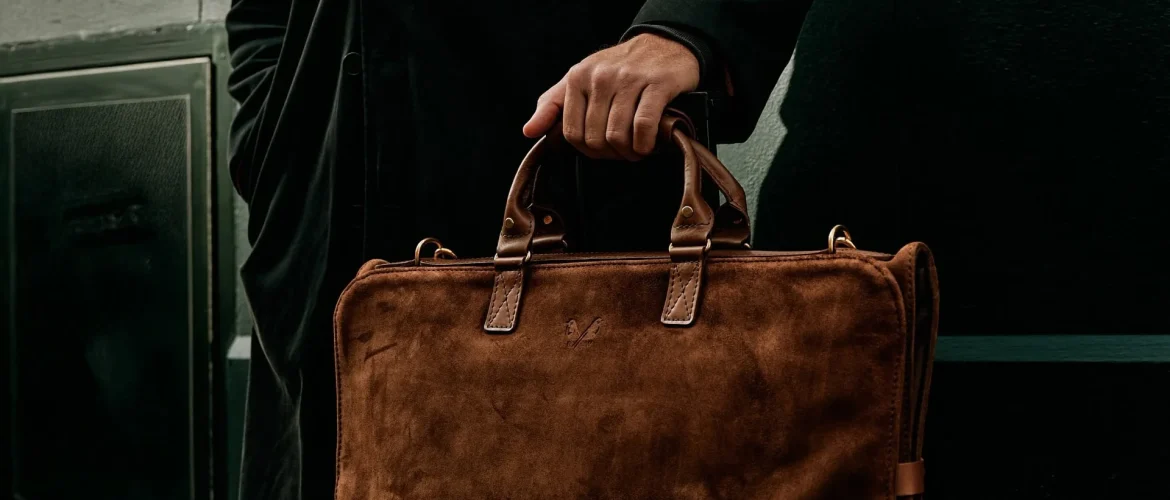
The Quiet Luxury Wardrobe for Men
The quietest wardrobe a man can own is also the freest. Once he settles on a small set of clothes that fit perfectly and are made exceptionally well, he removes fashion from his day altogether. There is less to decide each morning, nothing to keep up with each season and nothing that needs explaining. The clothes stop doing the talking, and what remains is the impression of a man entirely at ease in them.
The case for a uniform
The pieces are familiar for a reason: a navy jacket, a pale blue shirt, grey or stone trousers, a brown suede loafer. None of them is new, and none needs to be. Their value lies in proportion and cloth, and in the fact that they look right almost anywhere a man is likely to find himself.
What has changed is the idea of authority in dress. The pinstripe and the hard-shouldered suit once announced power, and to many eyes they now look like effort. The modern equivalent is softer. It belongs to the man who wears an unstructured jacket over a fine knit as comfortably at a board meeting as at a long lunch.
A uniform in this sense is a starting point rather than a rulebook. The men who dress best within it adapt it to their own lives, climates and tastes. Quiet luxury rewards discernment, and discernment is personal.
Fit before everything
No fabric, label or detail can rescue a garment that doesn’t fit. A modest jacket cut precisely to its wearer will always look more expensive than a celebrated one that hangs badly. A good tailor is worth more to a quiet wardrobe than any single purchase.
The current taste for softer, easier tailoring makes this more important. Relaxed tailoring depends on fluid cloth and deliberate proportions: a shoulder that follows the body, a jacket length that flatters, trousers that break cleanly. Without those, relaxed simply looks too big. A blazer that seems borrowed from a larger friend has been bought in the wrong size. Some men suit the softer silhouette and others look better in clean, close tailoring. Knowing which applies to you is the first decision in building the wardrobe.
Texture does the work of a logo
When nothing on a garment carries a name, the eye goes to the surface, and texture becomes the signature. Suede, flannel, brushed cotton, fine cashmere and soft leather all reward close attention in a way flat, shiny fabrics rarely do. A chocolate suede jacket or a charcoal flannel trouser looks rich without displaying anything.
Tonal dressing, building an outfit in shades of a single colour, is one of the most effective quiet techniques, provided the textures vary. Charcoal worsted trousers with a grey cashmere crew neck and black suede loafers read as considered and modern. The same outfit in a single flat fabric would look like a uniform in the wrong sense.
| Tone | Combination | Why it works |
|---|---|---|
| Grey | Charcoal flannel trousers, mid-grey cashmere crew neck, black suede loafers | Three weights of the same colour give depth without contrast |
| Brown | Stone cotton trousers, tobacco knit, chocolate suede loafers | Warm tones layer naturally and suit daylight |
| Navy | Navy wool trousers, navy merino roll neck, dark brown suede boots | A near-uniform lifted by the change of fabric at the feet |
| Cream | Ecru trousers, oatmeal cashmere, tan suede loafers | Soft and summery, provided the cloth is substantial |
The case for exceptional knitwear
Where the investment should go depends on how a man lives. For someone in tailoring most days, an excellent jacket and skilled alterations may matter more than anything else. For someone who lives in knitwear, fine cashmere and merino will do more for the wardrobe than another suit.
Quality in knitwear is also less obvious than it seems. Softness in the shop is no guarantee of longevity. Fibre length, the construction of the yarn and the density of the knit decide whether a sweater holds its shape or pills and stretches within a season. Even the best cashmere needs careful washing, folding and rest between wears.
The details mark the man who knows. A fine-gauge roll neck sits beautifully beneath the collar of an overcoat. A V-neck worn over a poplin shirt, with a small margin of cuff showing at the wrist, looks finished without trying. In both cases the knit should be fine enough to lie close to the body and never bunch under a jacket.
The shoe decides
A quiet wardrobe is finished at the ankle, and the wrong shoe can undo much of what sits above it. Suede loafers in tan, chocolate or navy, leather derbies and Chelsea boots carry the look most naturally. In warmer months a suede loafer worn with a no-show sock, or none at all, gives the cleanest line, whether with tailored trousers and a linen shirt or with chinos and a knitted polo.
Trainers have their place too. A clean, minimal leather trainer suits a relaxed wardrobe well, and for some men it is the everyday shoe. Heavily branded or very chunky designs tend to pull against the look, since they draw the eye in a way the rest of the clothes deliberately avoid. Whatever the choice, the shoe should look chosen rather than grabbed on the way out.
Let one detail lead
When the clothes are simple, details carry more weight. A fine watch, a good leather belt or a well-made pair of sunglasses can each lift a plain shirt and trousers. Several statement pieces worn together tend to compete, so the most effective approach is usually to let one detail lead.
Watches are a matter of taste. Many men who dress this way prefer a mechanical watch on a leather strap, which shares the craft and longevity of the rest of the wardrobe. Others will reasonably choose something practical, and a quiet wardrobe has room for both.
The makers worth knowing
The familiar Italian houses are well documented, and tailors such as Anderson & Sheppard and Cesare Attolini appear in our guide to the quiet luxury brands worth knowing. The makers below are less often discussed, and each would reward a well-informed man discovering them for the first time.
Sartoria Dalcuore, Naples
Sartoria Dalcuore was founded by Luigi Dalcuore, who came to tailoring as a teenager and opened his first atelier near Piazza Municipio before eventually settling on Via Caracciolo. Today the house is led by his daughter Cristina and her husband Damiano Annunziato. The Dalcuore cut is recognisably Neapolitan, soft and largely unstructured, with a more natural shoulder than many of its neighbours and a notably high armhole. Its bespoke tailors travel to clients around the world, which keeps the house unusually personal for its reach. It has also built its own ready-to-wear workshop near Naples rather than handing that work to outside factories.
Ring Jacket, Osaka
Ring Jacket was founded in Osaka in 1954 with a simple ambition: ready-to-wear tailoring as comfortable as a custom-made suit. For much of its history it worked quietly for other retailers, and its own label arrived only in the 1990s. The house has studied Neapolitan tailoring closely. Its jackets combine soft shoulders and extensive handwork with a Japanese rigour in construction, and the interest lies in how much comfort that construction delivers. Outside Japan it is stocked by only a handful of specialist shops.
Auralee, Tokyo
Auralee was founded in Tokyo in 2015 by Ryota Iwai, and everything begins with fabric. The team selects raw fibres directly from farms abroad, and these are spun into the house’s own yarns and woven at specialist Japanese mills. The garments built from them are restrained: easy trousers, fine knits, quietly coloured shirts. Their real character lies in a hand and a drape developed from the yarn up, which is why the clothes reward touch more than a glance.
A.Presse, Tokyo
A.Presse was founded in 2021 by Kazuma Shigematsu, who prefers to call himself an editor rather than a designer. The label describes itself as a clothing editorial department. It takes classic pieces from American, French and Japanese vintage and refines their proportions, fabric and finish. The surprise is in the materials: a jacket that looks like everyday workwear may be cut in washed silk, a plain blazer in cashmere. The Tokyo flagship sits in an unassuming building in Jingumae, and the house remains independent with very few shops of its own.
William Lockie, Hawick
William Lockie has made knitwear in Hawick, in the Scottish Borders, since 1874, and its premises on Drumlanrig Square have never moved. While many famous Scottish names have closed or moved production abroad, Lockie remains one of the few Hawick mills still doing nearly everything in-house. It has never chased fashion attention, and that restraint has served it well. It is a natural alternative to the familiar Italian knitwear houses.
Belgian Shoes, New York
Belgian Shoes was founded in the mid-1950s by Henri Bendel, nephew of the founder of the New York department store that bore the same name. Its soft loafers are made by hand in Izegem, a historic centre of Belgian shoemaking. They are sewn inside out, then turned, and finished with a small bow on the vamp. The house sells through its own shop in Manhattan rather than through the usual luxury channels. It is a loafer many New Yorkers recognise instantly and most of the world has never seen.
Saint Crispin’s, Brașov
Saint Crispin’s is a small, family-owned house with roots in Vienna and a workshop in Brașov, Romania, where traditional shoemaking skills survived when industrial production replaced them elsewhere. Its shoes are hand-welted and made in limited numbers, largely to order. The tell for those who know is the row of wooden pegs in the waist of the sole. Most people will never notice it, which suits the house’s clients very well.
The quiet wardrobe at a glance
| Piece | What to look for | What tends to work against it |
|---|---|---|
| Jacket | Soft shoulder, natural canvas, fluid cloth | Hard padding, shine, visible branding |
| Shirt | Pale blue or white poplin, oxford or linen | Contrast stitching, oversized collars |
| Trousers | Flannel, cotton or worsted in grey, stone or navy | Very skinny cuts, excessive length |
| Knitwear | Fine-gauge cashmere or merino with a dense, even knit | Soft but loosely knitted yarns that pill or stretch |
| Shoes | Suede loafers, leather derbies, Chelsea boots, minimal leather trainers | Heavily branded or very chunky trainers |
| Details | One quiet watch or a good belt | Several statement pieces competing at once |
The LXRY view
A man who has found his uniform has stopped trying to be noticed, and that is precisely why he is. The quiet wardrobe is built on fit, cloth and restraint rather than on the label inside the collar. Within those principles there is plenty of room for individuality. Its most valuable quality cannot be bought at all: the ease of a man in clothes that look as though they were made for him.
Frequently asked questions
What is quiet luxury for men?
Quiet luxury for men is a way of dressing built on exceptional fit, fine materials and understated design, with no visible logos. It favours a small, consistent wardrobe of classic pieces over seasonal trends, adapted to the wearer’s own life and taste.
What are the essential quiet luxury pieces for men?
A navy jacket, pale blue and white shirts, grey and stone trousers, fine knitwear and brown suede loafers form a reliable core. A single quiet watch or a good belt completes the wardrobe.
Which brands do men use for quiet luxury?
Beyond the well-known Italian houses, discerning men seek out makers such as Sartoria Dalcuore in Naples, Ring Jacket in Osaka, Auralee and A.Presse in Tokyo, William Lockie in Hawick, Belgian Shoes in New York and Saint Crispin’s in Romania.
Can you wear trainers with a quiet luxury wardrobe?
Yes. A clean, minimal leather trainer suits a relaxed wardrobe well. Heavily branded or very chunky trainers tend to work against the look, so many men keep suede loafers, derbies or Chelsea boots for most occasions.
Does expensive cashmere always last?
No. Longevity depends on fibre length, yarn construction and knitting density as well as care. Softness alone is a poor guide, and well-made cashmere still needs gentle washing and rest between wears to hold its shape.
Is relaxed tailoring part of quiet luxury?
Yes, provided the cloth is fluid and the fit is deliberate. Relaxed tailoring that is simply too large looks careless, and some men are better served by clean, close tailoring instead.
What is tonal dressing?
Tonal dressing means building an outfit in shades of a single colour, such as charcoal, grey and black. It looks most refined when the fabrics vary, so the outfit has depth rather than appearing flat.
Explore LXRY
_____________
Discover more through LXRY.
From exceptional travel and private experiences to fine watches, fashion, interiors and specialist services, LXRY connects readers with a carefully selected network of luxury businesses.
Interested in something you’ve read? Contact LXRY and we’ll help direct your enquiry to a relevant partner.
Explore: Men | Women | Travel | Lifestyle | Partner Network
Enquire with LXRY