
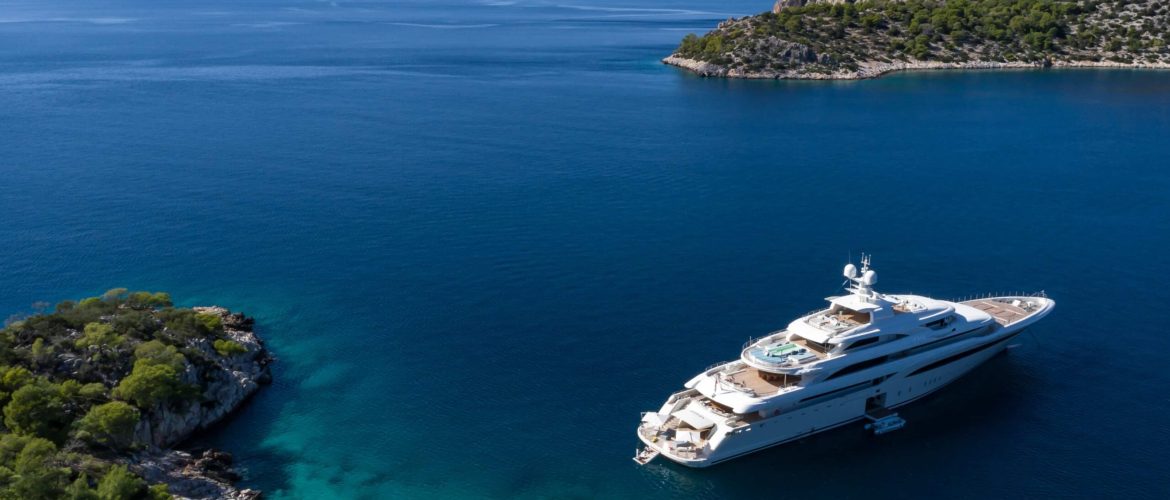
The Mediterranean Destinations Best Experienced By Yacht
There is a category of place that resists the conventional approach to travel. The infrastructure was not built for volume, the most interesting coastline is not accessible by road, and the experience of arriving by land feels immediately like a compromise. The Mediterranean has more of these places than anywhere else in the world, and the best of them share a common quality: they were always meant to be approached from the water.
Amalfi Coast, Italy
The Amalfi Coast is one of the most photographed stretches of coastline in the world and one of the most difficult to move through. The road that connects its villages is narrow, shared, and in high season carries more traffic than it was ever designed to handle. The towns themselves are beautiful and genuinely worth the effort, but the effort is considerable when the approach is overland.
From the water the calculation changes entirely. The coast reveals itself differently, the cliffs and villages arranged in a way that no road offers. Anchorages off Positano and Ravello allow guests to arrive at their own tempo, tender ashore for lunch or an evening, and return to the vessel before the town fills with the following morning’s visitors. The experience is not faster. It is simply on entirely different terms.
Sardinia
Sardinia’s northeast coast, the Costa Smeralda, has a reputation for glamour that it has maintained for decades. Porto Cervo remains the social centre of the European summer for a particular kind of visitor, and in July and August the marina reflects that. What the island offers beyond that well-documented stretch is considerably less visited and considerably more interesting.
The western coastline, the waters around the La Maddalena archipelago, and the quieter anchorages in the south require either significant local knowledge or the freedom to move without a fixed itinerary. A yacht provides both. The water here is genuinely exceptional, the kind of clarity that makes most other Mediterranean destinations feel ordinary by comparison, and the ability to anchor away from established tourist routes is the difference between Sardinia as a postcard and Sardinia as a place.
Corsica
Corsica sits between the French and Italian worlds without fully belonging to either, and that quality extends to how it receives visitors. The island has resisted the kind of development that has softened the edges of other Mediterranean destinations, and arriving by yacht is in many ways the approach most consistent with what the island actually is.
The Strait of Bonifacio, between Corsica’s southern tip and Sardinia, is one of the most striking passages in the Mediterranean. The interior anchorages along the western coast offer shelter and seclusion in roughly equal measure. Corsica rewards guests who are not in a hurry, which is precisely the condition a well-planned charter creates.
The Greek Islands
The Greek archipelago contains more islands than any reasonable itinerary can cover, which is partly the point. The Cyclades are the most visited and for good reason, Santorini and Mykonos having established themselves as the default entry point for first-time visitors to the region. What a yacht allows is the movement between those islands and the ones that sit an hour further in any direction, places where the tavernas are not yet optimised for tourism and the anchorages are not shared with a hundred other vessels.
The Ionian islands to the west offer a different character entirely, greener and less visited than the Cyclades, with a sailing culture that has developed over generations. The Dodecanese in the east carry the weight of a longer history, Rhodes and Patmos among them. The islands worth finding in any of these groups are rarely the ones that appear first in a search.
Croatian Coast
Croatia entered the mainstream travel conversation relatively recently and has since become one of the most discussed summer destinations in Europe. The Dalmatian coast is legitimately beautiful, and the old towns of Dubrovnik, Split and Hvar have earned their reputations. They have also, particularly in summer, earned a level of visitor volume that changes the experience significantly.
The answer, for the traveller who wants Croatia without the compression, is to move. The islands that sit between the coast and the open Adriatic, Vis, Lastovo, Mljet, are quieter, less developed, and in some cases genuinely remote. A charter itinerary that uses Dubrovnik or Split as a starting point and moves outward from there captures everything the coast offers while avoiding most of what makes it difficult.
French Riviera
The French Riviera is the oldest entry on this list and in some ways the most complicated. Cannes, Nice, Monaco, Saint-Tropez. The names carry associations that are both accurate and incomplete. The Riviera in high season is crowded and expensive in the way that all genuinely desirable places eventually become, and the experience of arriving by road or commercial flight reflects that.
From a yacht the Riviera reassembles itself into something closer to its original proposition. The approach to Monaco from the water during the Grand Prix, the anchorage off Saint-Tropez before the town wakes, the calanques east of Marseille that have no road access at all. The French coast was understood from the beginning as a place to arrive by sea, and that understanding has not aged.
The Mediterranean at its best is not experienced through its airports or its motorways. The coastline that defined the idea of a certain kind of summer was always most itself when approached slowly, from the water, with nowhere in particular to be by any particular time.