
They Sold a Domain for $70 Million. Then the Digital Land Grab Began
AI.com sold for $70 million in 2025. In the twelve months since, short domain assets have been moving faster than at any point in the last decade. Your category keyword may still be available. The window is narrowing.
In 2025, AI.com changed hands for $70 million.
Not a company. Not a product. Not a patent portfolio or a piece of intellectual property built over decades. A domain name. Sixteen characters including the dot. The person who registered it years earlier did not know what they were sitting on. The person who bought it for $70 million understood exactly what they were paying for.
They were paying for a category. The right to own, at internet scale, the most searched and most valuable two letters in the current digital economy. They were paying for a postcode in a city that does not have planning permission and cannot build new streets.
That sale changed the conversation.
What happened next
In the twelve months following the AI.com transaction, short domain assets began moving with a speed and consistency the market had not seen in years.
Single dictionary words at seven figures. Four and five letter combinations that represent entire industries — gone, or priced beyond the reach of anyone who was not already paying attention. The .com extension, long considered the only address worth having, became the market that had already closed for most buyers. The premium stock was either taken or listed at prices that made negotiation feel academic.
The buyers who understood what was happening moved to where the inventory still existed. They moved to .io. They moved to .co. And within those extensions they moved fast, because the same logic that applied to .com — scarcity, category value, brandability — applied there too. Just a few years behind.
That gap is closing.
Digital land. The same logic.
The real estate comparison is not a metaphor. It is the most accurate way to understand what is happening.
The person who bought in Mayfair in 1985 looked early. The person who saw the value in Miami Beach in 2002 looked eccentric. The person who acquired warehouses in East London before the regeneration looked like they were taking a risk. Each of them was simply reading a market that others had not yet reached.
Domain assets follow the same logic with one significant difference. There is no planning permission in the digital world. Nobody can build a new .com. Nobody can create more single-word .io registrations in the finance or healthcare or wealth management categories. The supply is what it is. When it is gone, the only transaction available is with whoever currently holds it and whatever price they decide to ask.
The people buying short domain assets now are making the same calculation those property investors made. Some will build on what they acquire. Others will hold it until the right buyer arrives. Both are rational strategies in a market with genuine scarcity.
Why short wins
The shift toward shorter names is not aesthetic. It is functional and it is accelerating.
A brand that is difficult to spell loses searches. A name that requires explanation loses introductions. A domain that cannot be read aloud clearly in a noisy room loses every conversation it needs to survive. The brands that understood this early went short. The brands that are understanding it now are finding that the short options they wanted are no longer available at the price they expected.
Vowel-dropped category keywords represent the intersection of two trends that are both still in motion. The first is the move toward brevity — four and five letter names, stripped of unnecessary characters, that sound like the category they represent without being the full word. The second is the migration away from .com toward extensions that still have inventory. .io has become the extension of choice for serious digital brands across finance, technology, healthcare and professional services. .co has followed a similar trajectory.
The names that sit at that intersection — short, category-relevant, .io or .co — are the assets that have been moving fastest in the last twelve months and will continue to move as the market catches up with what early buyers already understood.
Rare Assets
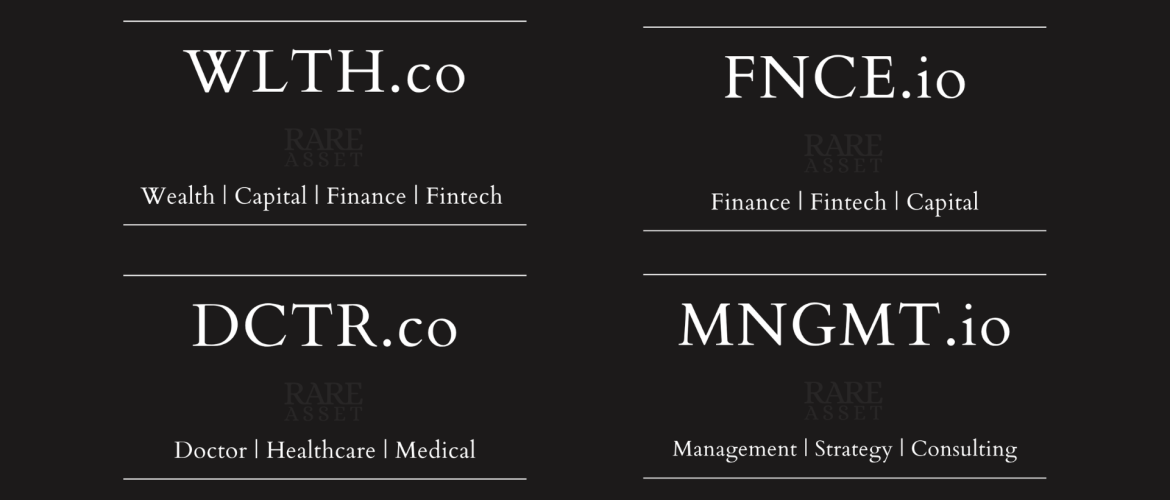
Within the LXRY Rare portfolio are category-defining digital assets spanning wealth, healthcare, finance, lifestyle, travel and private access. Each represents a position within a market where genuine inventory is becoming increasingly difficult to acquire.
WLTH.co — FNCE.io
Selected assets are available privately through direct enquiry.
The window
This is not a market that rewards patience in the way that other asset classes sometimes do.
The buyers who acquired the right .com names in the late nineties did not wait to see whether the internet would become important. The buyers who moved into .io and .co early did not wait until the extension was fashionable. The assets that are available today at four and five figure prices exist in a market that has already demonstrated, at the highest level, what category ownership is worth.
$70 million for two letters and a dot.
The categories that have not yet been claimed at this level are still available. Not because they are not valuable. Because not everyone has done the calculation yet.
Some of them are listed on the Rare page. The rest of the market will catch up eventually. The question is whether the asset you want is still available when they do.